
If you’re shopping for your first tow truck, or adding to a growing fleet, you’ve probably asked the rollback vs. wrecker question more than once. It’s one of the most common calls we get at Nussbaum Equipment, and it makes sense.
The truck you choose shapes the jobs you can take, the customers you can serve, and how your towing business grows over the next decade. Rollbacks and wreckers each play a distinct role in the towing industry.
Here’s what each one does best, so you can figure out which fits your operation.
How a Rollback Works
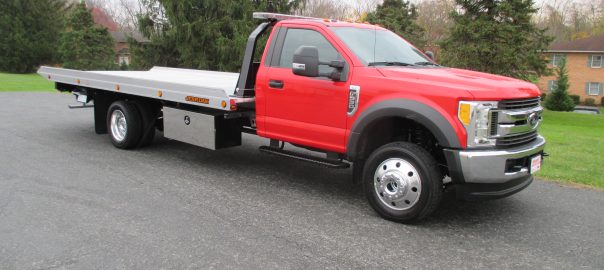
A rollback, sometimes called a car carrier or flatbed, uses a deck that tilts and slides back to touch the ground. A winch pulls the vehicle onto the deck, then the whole bed tilts up, and you drive away.
The customer’s vehicle rides entirely on the bed, so none of its wheels touch the road. That’s the big advantage. The vehicle doesn’t wear its tires, and you don’t have to hook up underneath.
Rollbacks are the go-to choice for:
- Everyday passenger cars and light trucks. Sedans, SUVs, crossovers, minivans.
- Lowered or modified vehicles. Low ground clearance is no problem when the whole car rides on the deck.
- All-wheel drive and transmission issues. No wheels turn on the way to the shop.
- Accident recovery where the car can’t roll. If it won’t move under its own power, the winch does the work.
Rollbacks are our best sellers, and it’s easy to see why.
They’re also the most versatile towing equipment you can put on the road, because the flat deck can haul a lot more than cars.
A rollback can move almost anything that fits on the deck, such as forklifts, large tool boxes, lawn equipment, and shipping containers.
Trash companies even use rollbacks to drop off their compactors at job sites. As long as the load stays within your truck’s rated capacity, this kind of hauling work keeps your rollback earning money between tow calls.
Jerr-Dan’s lineup, including the XLP and MPL with No-Lube technology, keeps maintenance simple so your truck stays working.
How a Wrecker Works
A wrecker takes a different approach. Instead of carrying the vehicle, it lifts one end and drags the other. Most wreckers give you two tools to do that:
- A wheel lift. Arms slide under the tires of one axle and lift it clear of the road. This is the fast, standard hookup for repos, parking enforcement, and short tows.
- A boom. An extending boom reaches vehicles a rollback can’t get close to and winches them out of ditches, embankments, and mud. Heavy-duty towing setups pair a strong boom with stabilizers to recover semi-trucks and buses.
Wreckers shine when speed and vehicle recovery matter. A wheel lift gets you hooked up and moving fast in tight urban spaces.
The boom is where a wrecker really stands apart.
When a vehicle is disabled down an embankment or flipped over, a twin-line boom that extends can reach it, winch it back up, and set it on its wheels.
Two lines let you rig the vehicle at two points for more control. A rollback’s winch is built to pull a vehicle onto a deck, not to recover a rollover.
The tradeoff is that the towed vehicle’s other axle rolls on the pavement. For four-wheel-drive and all-wheel-drive vehicles, many operators put wheel dollies under those wheels to keep the whole vehicle off the ground.
Different Trucks, Different Roles
Each truck has its own job in the towing industry:
- A rollback is your hauler. It carries vehicles, equipment, and cargo with nothing touching the road.
- A wrecker is your recovery tool. It hooks up fast for short tows, and its boom pulls vehicles out of ditches, up embankments, and back onto their wheels.
So the rollback vs. wrecker decision comes down to the work you want to take on.
Rollback vs. Wrecker: Which One Do You Actually Need?
Here’s the honest answer we give operators who call our showroom: most towing businesses start with a rollback because it handles the widest range of routine calls.
If you’re running police rotation, motor club work, or general service towing, a rollback covers most of it.
A wrecker makes sense when:
- You’re bidding on contracts that require wheel lift or boom work.
- You’re expanding into heavy-duty towing for commercial vehicles.
- You already have a rollback and want to cover the jobs it can’t.
Plenty of operators eventually run both. The rollback handles the daily calls and hauling jobs, while the wrecker takes the recoveries, rollovers, and heavy pulls.
If you’re at that stage, talk through configurations with someone who knows the Jerr-Dan lineup inside and out. Deck length, boom capacity, and chassis pairing all change what the truck can do.
A Few Questions to Ask Yourself
Before you decide, there are a few things you’ll want to consider.
- What calls do you get most? Daily light-duty tows and equipment hauling point toward a rollback. Recovery, rollovers, and commercial work point toward a wrecker.
- What’s in your area? Rural roads and highways generate more recovery work. Suburbs and cities generate more standard tows.
- What’s your growth plan? If heavy work is on your radar, a wrecker belongs in the conversation now.
Talk It Through With Us
You don’t have to figure this out alone. We’ve been selling and servicing Jerr-Dan tow trucks for 60 years, and we’ll help you match the equipment to the work you actually do.
Three generations of family ownership have taught us one thing: the right truck for your business beats the flashiest one on the lot every time.
Ready to settle the rollback vs. wrecker question for your operation? Contact us through the website or stop by our showroom in Columbia, PA.
